
From Electric Cars To The Moon: Venturi's Voyage
Monaco will not be sending astronauts to the Moon but NASA is banking on Venturi’s technologies for their Artemis mission rover...
When, in 2004, Venturi decided to abandon internal combustion engines permanently and focus exclusively on electric power, few in the industry imagined that this route would one day be the trend. At the time, electric cars were still a niche market and investment was largely focused on traditional engines. Twenty years later, technologies developed by Venturi Space are set to equip the future lunar rover for NASA’s Artemis missions. Between these two milestones, the Monégasque company has built its expertise by exploring increasingly demanding environments, from the open road and speed record attempts to polar regions, before raising its sights to space.
Turning Point Takeover
For Gildo Pallanca Pastor, grandson of the construction magnate, cars were a passion from the age of 18. He competed in various events, from rally raids to the 24 Hours of Daytona. By the late 1990s, the Venturi brand was struggling and 35 potential buyers stepped forward. Gildo Pastor submitted the minimum takeover bid, €500,000 and, after months of proceedings, he acquired the brand and decided to relocate it to Monaco in 2000. The initial years were dedicated to rebuilding the company. In 2004, Venturi unveiled the Fétish, featuring an all-electric powertrain. The decision was far from universally acclaimed: the market was still in its infancy and few manufacturers were investing in the technology. Venturi took an even more radical step by developing its own components: engines, power electronics, batteries and energy management systems were all designed in-house. This mastery of the entire technological chain gradually became the company’s hallmark. The following years were dedicated to improving vehicle performance, breaking several speed records and collaborating with industrial partners such as Michelin and Mercedes, a strategy also applied to the Voxan electric motorcycle.
From Breaking Records To Polar Exploration
In 2009, upon returning from a mission to Antarctica, Prince Albert II asked Gildo Pastor to explore the feasibility of designing an exploration vehicle capable of operating in extreme weather conditions. Two years later, the Antarctica - the first electric polar exploration vehicle - was born. Designed to function at temperatures as low as -50°C, it served as a mobile laboratory. Testing enabled improvements in battery durability, electronic systems and the vehicle's ability to traverse particularly challenging terrain. A new idea then took shape: if a vehicle could operate in Antarctic conditions, certain technologies might also meet the demands of space exploration.
Space Venture
In 2021, Venturi established Venturi Space and assigned some of its teams to develop technologies for lunar vehicles. The challenge lay in adapting expertise gained in electric mobility to an even more hostile environment. On the Moon, temperatures range from -240°C to +130°C, the surface is covered in abrasive regolith and long, lunar nights impose unprecedented constraints on energy storage. Research focused specifically on wheels, batteries and electronic energy management systems.
Artemis Mission Role
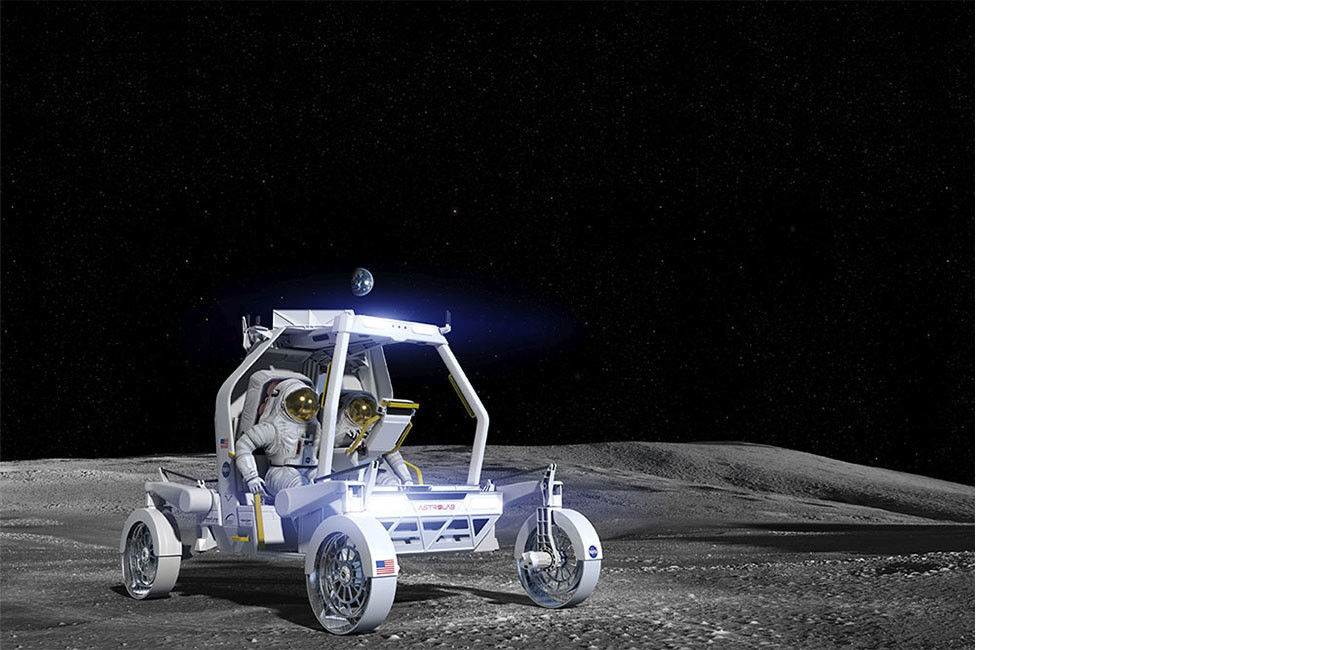
This expertise has now been recognised by NASA. The US space agency has selected the company, Astrolab, to develop the crewed lunar vehicle (CLV-1), the rover designed to transport Artemis astronauts to the lunar South Pole. Three technologies developed by Venturi Space will be integrated into this vehicle. The first involves hyper-deformable wheels, designed to maintain traction on lunar regolith, whilst minimising sinkage. Venturi is also supplying high-performance batteries capable of withstanding extreme temperature fluctuations, as well as the Battery Management System (BMS), responsible for continuously monitoring cell status, balancing their operation and ensuring the rover's power supply safety. For the Monaco-based company, this selection validates years of research dedicated to mobility in extreme environments. The Artemis mission is just one step: an initial demonstration version, the FLIP rover, is scheduled to reach the Moon in the second half of 2026; and Venturi is also working on the Mona Luna, a European rover with a first mission envisaged around 2030.
Four questions for Gildo Pastor, President of Venturi
"Venturi Astrolab has already presented a Mars-ready version of its FLEX rover"
Why do you think NASA chose you for the Artemis project?
Our US strategic partner, Venturi Astrolab, was selected by NASA because its CLV-1 represents the best solution amongst those proposed. It incorporates three technologies designed and manufactured by us, Venturi Space: hyper-deformable wheels, high-performance batteries and the BMS. These technologies are absolutely critical for operating on the lunar surface - an extreme environment with stringent reliability requirements.
What mattered was technological credibility. For several years, we have been developing, testing and refining these systems across Monaco, Switzerland and France. In the space sector, you don’t convince people with promises. You convince them through the quality of your teams, tangible test results, rigour and the ability to deliver critical technologies that meet the required high standards.
You announced a €250-million investment in Toulouse. If you combine the efforts undertaken in Monaco, Switzerland and the United States, along with seven years of R&D programmes, what is the total investment Venturi has dedicated to its space venture to date? And how far are you willing to go financially to achieve your lunar goals?
The efforts in the United States are not directly my doing, as Venturi Astrolab is a US-based company, with Venturi Space acting as its strategic partner. As you might imagine, the investment runs into the hundreds of millions of euros but I won’t say any more than that.
How far am I willing to go? It’s simple: all the way to achieving the goal we’ve set for ourselves! The next steps are major: the deployment of the FLIP rover within six months; followed by the CLV-1 starting in 2028 as part of NASA’s Artemis campaign: then comes FLEX and, around the turn of the decade, perhaps our Mona Luna will be operational up there, should ESA select our project. That’s quite something, isn’t it? |laughs] - and I haven’t even told you everything yet…
How does Venturi Space make money currently and when do you expect to reach profitability?
The CLV-1 rover from Venturi Astrolab, our US strategic partner, was selected by NASA to transport astronauts on the Moon. Since this vehicle is equipped with our technologies (wheels, batteries and BMSs), the initial industrial returns from these are now on the horizon. In this industry, the process involves investing, qualifying, manufacturing, delivering and demonstrating capabilities. Our goal is to achieve profitability through the gradual industrialisation of our technologies and the acceleration of lunar programmes over the coming decade. Just consider this: estimates suggest that over 100 lunar missions have been announced or are planned for the next 10 years! We are witnessing the dawn of a new industrial era.
If Elon Musk called you today to invite you to join a Mars mission, would you accept?
I would say that we are ready to talk to anyone who is making concrete progress in space exploration. However, I wouldn’t go to Mars just for the sake of the symbolism. What matters to me is that Venturi Space makes a useful, or even essential, contribution to a mission. If our technologies can enable a vehicle to drive on Mars, then yes, we would step up. Our objective is to enable human and robotic mobility on the Moon and subsequently on Mars. In fact, our partner, Venturi Astrolab, has already unveiled a Mars-ready version of the FLEX rover, which also features Venturi Space technologies.

Gildo Pastor, President of Venturi