Employment in Monaco: Growing Needs and Solutions Needed
In a Principality nearing full employment, companies are no longer just asking themselves how to recruit but also how to continue attracting, training and retaining the necessary talent.
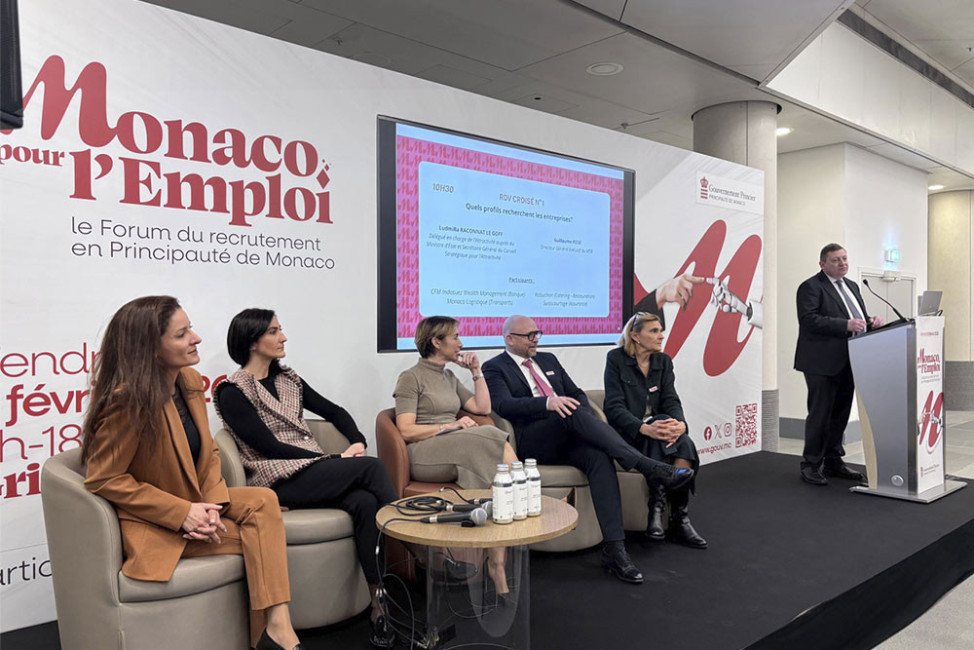
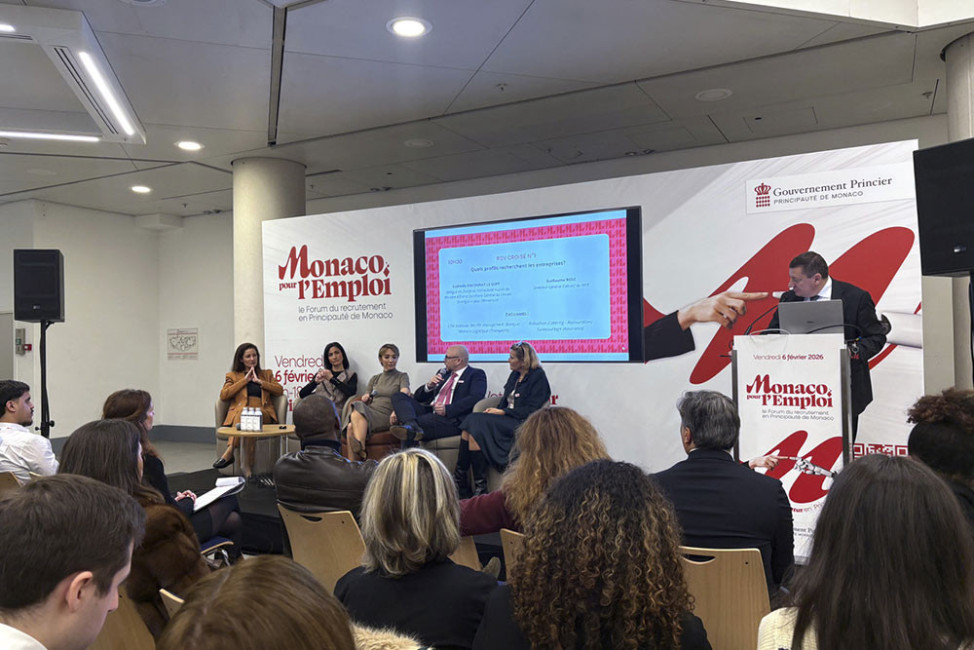
This is one of the key takeaways from the conference organised by the Monaco Economic Board (MEB) as part of the Employment Forum, which brought together government representatives and employers from a wide range of sectors, such as banking, logistics, insurance and luxury dining. One observation is clear: "Monaco has a particularly dense and diverse economic fabric for a territory of just 2 km²," as noted by MEB Executive Director Guillaume Rose; but this wealth is accompanied by growing pressures on certain professions, whether they be highly-skilled, technical or operational.
Recruitment needs across all sectors
The overview presented by the speakers demonstrates the scale of the need. In the banking sector, CFM Indosuez is seeking candidates with expertise in compliance, auditing and conformity, as well as data skills and, in the future, artificial intelligence. In the insurance sector, Swiss Courtage mentioned some 20 jobs up for grabs in core business roles - underwriters, sales representatives and claims adjusters – as well as in support functions, particularly IT and accounting. The same situation prevails in the luxury hotel and restaurant industry. At Robuchon Monaco, the main challenges are for operational roles in the kitchen and service, with particularly fierce competition amongst establishments in the Principality. At Monaco Logistique, opportunities encompass both administrative and technical roles: freight forwarders, air-sea freight agents, forklift operators, mechanics and, in particular, long-distance lorry drivers who, according to the company, have become a "rare commodity".
Similar situation in training, housing and transport
The primary obstacle is training. Several participants highlighted the lack of nearby training programmes precisely matching their needs. In logistics and insurance, the nearest specialised training centres are often located in Marseille or Aix-en-Provence. Once they graduate, young professionals do not always return to Monaco, deterred in particular by the cost of living on the French Riviera.
A second difficulty is housing and access to the Principality. Xavier Gluszyk of CFM Indosuez summed up a shared problem: attracting young graduates from prestigious schools becomes complicated when they then have to find housing in an expensive region, with an initial salary that doesn't always cover the cost of relocation. Even though salaries in Monaco remain higher than in neighbouring towns, the issue of housing remains crucial.
A third topic is mobility. All the speakers mentioned travel constraints, either explicitly or implicitly, as a major obstacle to recruitment.
Challenge of specialised recruitment - and mindsets
In addition to these structural obstacles, there is a more qualitative tension: the increasing specialisation of positions. In banking, employers are seeking ever-more technical profiles in professions heavily regulated by law; but Xavier Gluszyk also pointed to another, more internalised challenge: the temptation, amongst some managers, to systematically search for the 'unicorn' - the candidate already immediately operational, with the exact experience required for the position. In other words, the difficulty lies not only in the labour market; it also lies in companies' capacity to recruit differently, to be willing to invest more in training and to broaden the range of profiles they seek.
This issue is found in several sectors. Robuchon say they are ready to offer training, provided they can find "the right people." In the insurance sector, Swiss Courtage is working with the International University of Monaco to develop modules better-suited to its business. They all converge on the same idea: recruitment increasingly relies on partnerships between companies, training institutions and public authorities.
Real solution: shared company crèche
Leïla Trabé Chiha, Vice President of Monaco Logistique, highlighted a problem rarely at the heart of the employment debate: childcare. According to her, several employees have left the company after the arrival of their first child, due to a lack of suitable childcare options. Between distance from home, a shortage of daycare places and organisational difficulties, parenthood can become a reason for leaving, even for employees the company wished to retain long-term.
In response, a compelling idea emerged: that of a shared company daycare centre, not necessarily run by a single company but a collaborative system designed for several employers. Ludmilla Raconnat Le Goff has acknowledged that the topic deserves to be revisited.
In a tight labour market, the solution is far from simple. Attractiveness no longer rests solely on salary or the prestige of the region but also on the very real conditions in which employees are able to live and work.
By Milena Radoman - Monaco Economie