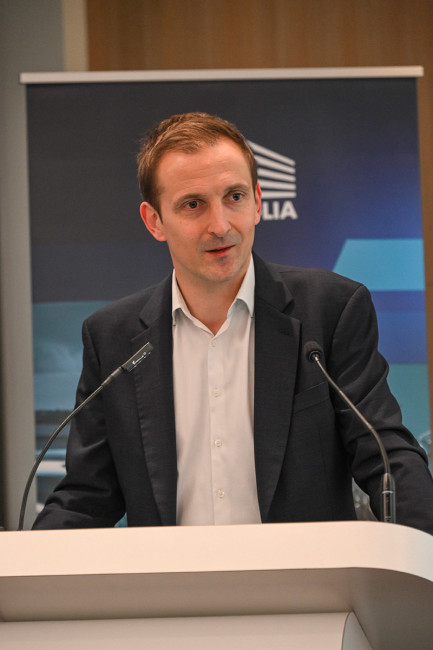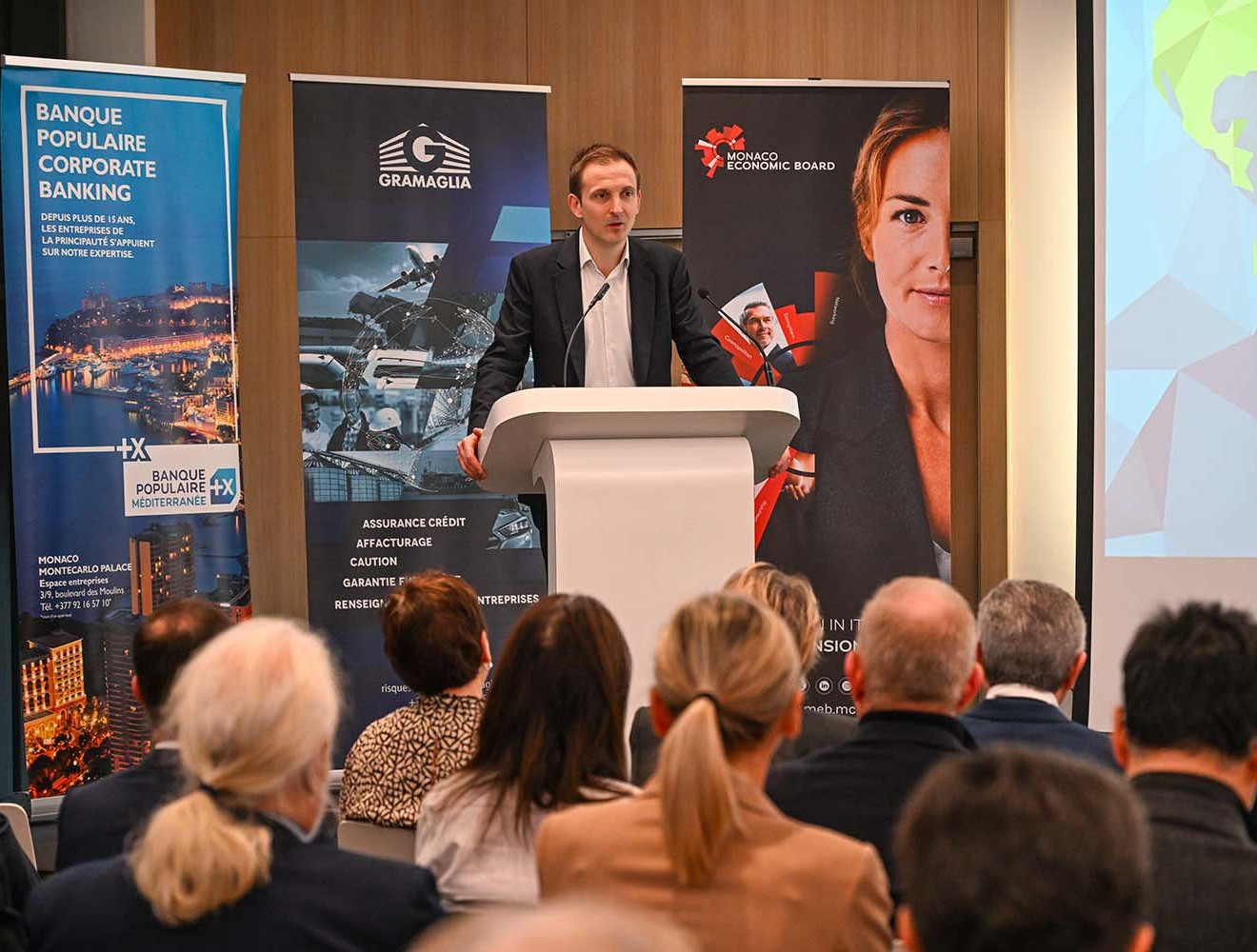
Jean-Christophe Caffet unveils the calm within the storm
On Tuesday, 10 February, at the Novotel Monte-Carlo, in partnership with Gramaglia and Banque Populaire Méditerranée, the Monaco Economic Board welcomed Coface’s Chief Economist, Jean-Christophe Caffet, ahead of the renowned Coface Risk Conference in Paris. The event offered a comprehensive and engaging macroeconomic presentation. Despite ongoing geopolitical upheavals, economic trends remain relatively stable.
Opening the conference, Jean-Christophe Caffet provided an overview of the global economy, describing it as “calm within the storm.” A paradox, he warned, that remains difficult to interpret: “I cannot yet tell you whether we’ve avoided the storms or if we’re in the eye of the cyclone.” A reminder that the current economic climate is defined by an exceptional level of uncertainty—where the only certainty is the prospect of further surprises.
A former TotalEnergies economist, Caffet also shared his insights on the energy transition. While achieving carbon neutrality by 2050 appears highly challenging—“even by 2100, I’m not entirely convinced,” he noted—the transformation is nevertheless well under way, continuing to shape economic and industrial policy worldwide. For Europe and China, both lacking in hydrocarbon resources, it is a matter of strategic independence. Energy companies are responding accordingly, as—contrary to popular belief—green electricity is now cheaper to produce.
The analysis also covered US trade policy, particularly the impact of protectionist measures. These, he explained, have proven largely ineffective, since their real cost falls mainly on American businesses and consumers, even though some foreign exporters have accepted shrinking margins.
Amid growing decoupling between the United States and China, Europe is likely to face a flood of Chinese products stemming from persistent overcapacity, posing an additional threat to its industrial base.
Inflation trends differ significantly across regions. In the United States, inflation is expected to remain above central bank targets through late 2026, while in Europe, inflationary pressures have eased considerably. However, “in the past 18 months, there have been 60 rate cuts by central banks in developed economies; the easing cycle is drawing to a close,” he pointed out.
The baseline scenario projects a slight slowdown in global growth to 2.6% in 2026 (-0.2%), mainly due to weaker performance in China. Downside risks remain predominant: “If you happen to spot any upside geopolitical risks of any kind, please let me know—I haven’t found any,” he joked. This fragility is already reflected in a significant rise in corporate insolvencies across many economies.
The conference, attended by around a hundred Monegasque business leaders, concluded with a lively Q&A session. It gave Jean-Christophe Caffet the opportunity to elaborate on the specific situations of certain countries and to highlight the risk of an artificial intelligence bubble bursting—one that could especially affect pure players who have multiplied their applications using AI. But that, he added, is another story.